
Setting Intentions
A prelude to redefining this space, Operant Sprituality, for myself

“Settle in. Notice your breath. Straighten your spine. Bring your hands to your heart, in Anjali Mudra. Set an intention for your practice.”

100% human-generated, flaws and all
Different schools of yoga have different ways of beginning one’s practice on the mat, but almost all begin with attuning to your body and breath. Some attune the mind — aka verbal behavior — to one’s intentions.
But not Bikram yoga, the discipline in which I was first trained.
When I first discovered yoga in my mid-20s, I dabbled, noncommittally using my free intro week at different studios across my city. When I found Bikram yoga — or, Bija Hot Yoga, my ex-Bikram instructor’s “illegal” interpretation of it— I was hooked and stopped hopping.
Bikram yoga appealed to my perfectionism. There was no room for error or interpretation; everything expected of you was clearly stated and objectively doable. The postures, the instructional dialogue, the heat, the challenge to not leave the room, no matter how damn hot you got — consistent.
Class always started predictably:
“We begin with pranayama. Breath of life. Come standing, center of your mat, heels and toes touching. Interlace your fingers, strong grip, hands touching chin like glue. Inhale through the nose…”
No “intentions.” No nonsense. Just poses. Heat. 90-minutes of instructor- self-imposed torture.
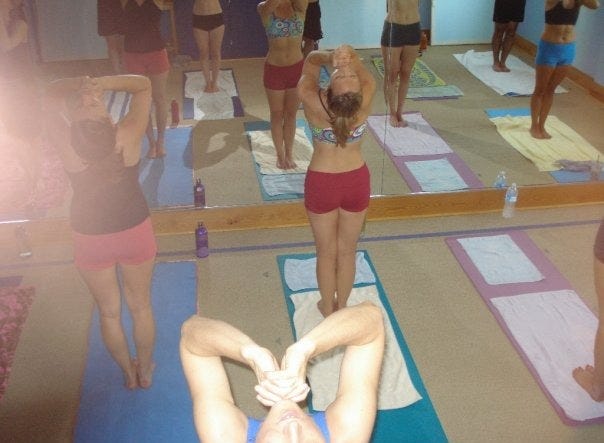
When I moved to L.A., yoga-teacher-training (YTT) certificate in hand, I had a punishing experience in a Bikram class, from Bikram himself. That’s a different essay, but I mention it to say, I started practicing other types of yoga again. And almost every class started with setting intentions, which mildly irked the impatient, workout-oriented woman in my 20s who just wanted to get on with it, already!
My intentions?
My intention was to practice yoga. Duh! My intention was to ‘get a workout.’ My intention was not to leave before the class even starts, lady!
I’d roll my eyes at former me, but I’d rather laugh. Bless her little heart. Oh, how far you’ve come but still have to go!
“An intention is something you can come back to during your practice, when you feel yourself drift.”
Aha! After hundreds or thousands of practice hours, setting intentions irked me less and less. Alongside my behavior analytic training, I started seeing them for what they were:
Verbal signposts, erected before traveling, meant to guide a subsequent self back on course.
Rules. Or tacts of one’s motivating operations, contingency-specifying stimuli. I haven’t settled on how they function, exactly, but verbal signposts is good enough for now. Words to come back to when you’re drifting, off the mat, in whatever self-talk has you distracted from the doing and being.
Contorting one’s body into odd shapes, holding the asana for a minute or more, in a 105-degree room, with 80% humidity?
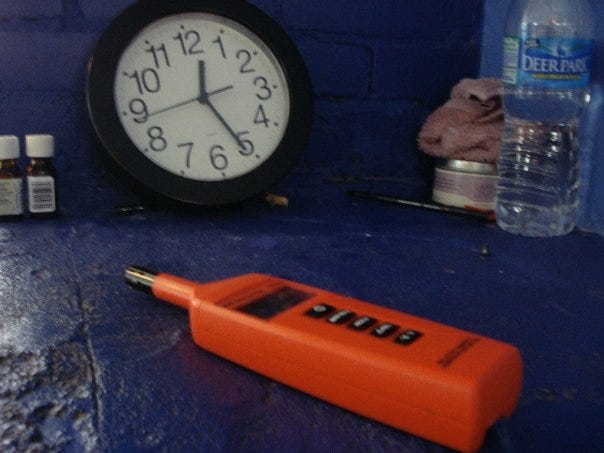
Yeah, looking back, setting intentions before a Bikram yoga practice would have helped me and all my students. When out of breath, nauseated, and feeling lightheaded, like I just needed some cool air and a gallon of water, I could have modeled “better” intentions than merely a workout:
My intention is to stay present throughout this experience. My intention is to participate. My intention is to listen to what my body needs, not what my conditioning says it needs. My intention is to be here, while it lasts, because discomfort is temporary and, if you watch yourself through it, an incredible teacher.
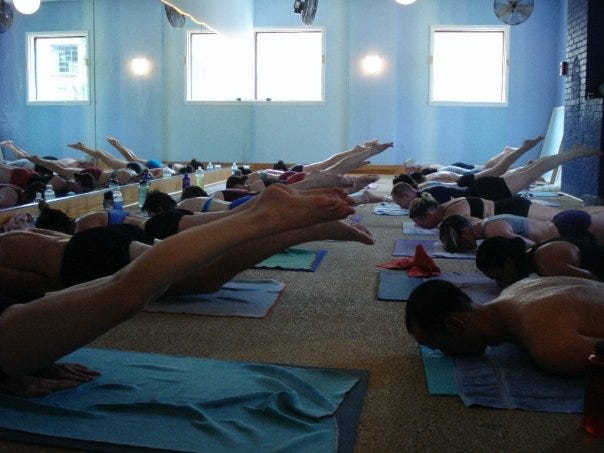
“I can’t do this” becomes “I intend to stay present.”
“I’ll just sit this one out” becomes “I intend to participate.”
“It’s hot, I need to leave” becomes “I intend to listen to my body, not mind conditioning.”
“F this instructor” becomes “I intend to be here; discomfort is temporary.”
OK, fine, the last one — anger at the instructor — is harder to overcome with intention alone.
I recently realized that setting intentions before any practice is probably helpful.
Yoga, writing, practicing a new language or instrument…
What are my intentions for this practice?
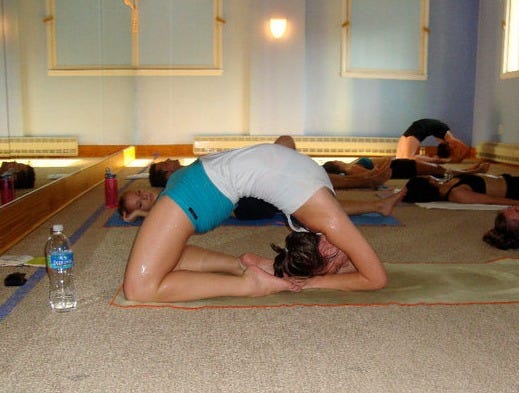
It’s okay if they’re not perfect. Nothing is — except maybe my Eka Pada Kundinyasana II, circa 2010:
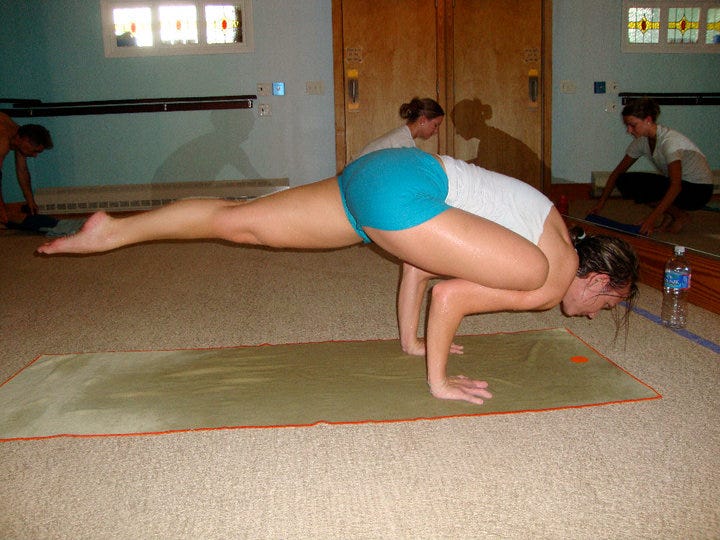
(That’s a joke. I used to self-deprecate a lot, so now I do the opposite whenever I can. It makes me uncomfortable, self-praise, but that’s the practice.)
Then I realized, the concept of “practice” could be expanded:
We could set intentions before doing other things, too! Before interpersonal interactions. Before work tasks. Before our use of social media, before opening any given app. Before setting intentions themselves…
That last one is another joke. I used to be funnier. But seriously:
How would setting intentions before any given activity change how we show up, for ourselves and others, across our day?
It’s an empirical question, like all questions about our behavior. One you can test out yourself.
I’m going to test it by redefining my intentions for this space, and seeing how it affects my posting, my writing. I might not use a single-subject design, as it might be hard to identify an objective measure and/or implement a control condition, but I think we will see an increase in articles and a decrease in self-imposed struggles like, “Where do I put this one-off musing about a snail on a lacrosse ball?”
Stay tuned for Part 2, or “What is Operant Sprituality?” Next time. No telling when. ;)

Peace, love, and stimulus control,
Jennifer
P.S. The coming “rebrand” of Operant Spirituality is part me trying to get a hold on my social media use (post coming one day), part mass organization/ lowest-hanging fruit search (one can export all posts from a publication, into a tidy file, which appeals). Hope you bear with me. It makes sense to me, at present. Thank you!

There's so much to love about this post Jennifer!
To begin with, I've become a huge fan of setting intentions - in everything. I think it's the partner of attention.
And then there's the fact that I've started working on a yoga post too 🤭 except mine'll be titled, Redneck Yoga. So I'll probably link this one in case someone is serious about learning.😉 Namaste🙏
No need to discuss how you take on something you will surely commit to it. I look forward to your intentions becoming reality. ✌️❤️😌